

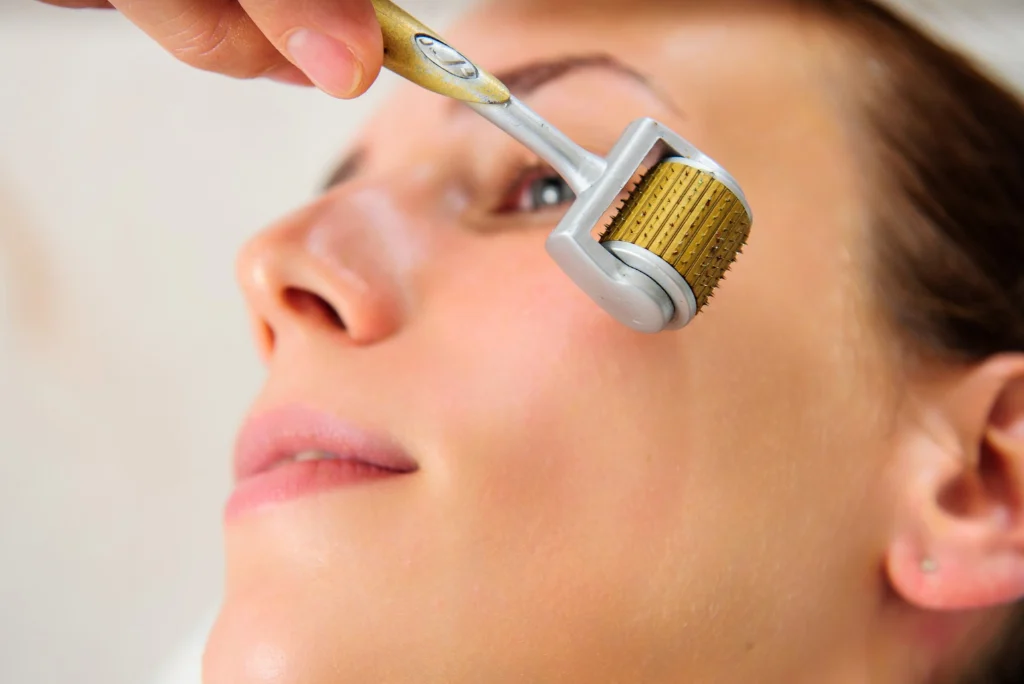
A derma roller costs less than a cup of coffee in most online stores here, which is exactly why I see the damage it causes more often than the results it promises. Patients arrive with fresh dark marks across the cheeks, or with acne that spread after one enthusiastic session, and almost none of them were told the single detail that decides whether a roller does anything at all.
That detail is needle length. Everything else is marketing. So here is the honest version of how derma rollers work, where they genuinely help, and where they quietly make brown skin worse.
What Does a Derma Roller Actually Do to Your Skin?
A derma roller is a handle with a drum of fine needles. Rolled across the skin, it creates thousands of tiny punctures. Your skin reads those punctures as injury and responds by producing collagen and elastin during repair. That controlled-injury principle is sound, and it is the same idea behind professional microneedling.
The problem is that the principle only holds if the needles reach the right depth. Collagen lives in the dermis. If the needles never get past the outer layer, you have irritated your skin without triggering any of the repair you were hoping for.
Why Needle Length Decides Everything
Needle length | What it actually reaches | Realistic effect |
0.2 to 0.3 mm | Outer layer only | Helps products absorb. No collagen change |
0.5 mm | Upper skin layers | Mild texture and glow. Very limited scar effect |
1.0 mm | Into the dermis | Real collagen response, but clinic territory |
1.5 mm and above | Deep dermis | Medical procedure. Not an at-home device |
Most rollers sold online here are 0.5 mm or under. They are not useless, but they are a product-absorption tool, not a scar treatment, and they are sold as the second thing.
Do Derma Rollers Work at Home, or Only in a Clinic?
At home, within a narrow brief, a short-needle roller can improve how skin looks and feels. It will not resurface scars, close enlarged pores or lift pigmentation in any meaningful way.
Three mechanical facts explain most of the disappointment:
- Rolling is not puncturing. A roller enters at an angle, drags, and exits at an angle. That creates small tears rather than clean vertical channels. A motorised pen stamps straight in and out, which is gentler on the tissue and more consistent in depth.
- Needles blunt quickly. After roughly ten to fifteen uses the tips are no longer sharp. Blunt needles tear skin instead of piercing it, which means more trauma for less benefit.
- You cannot sterilise a roller at home. Alcohol wipes the surface. It does not sterilise the barrel or the gaps between needles, and that is where bacteria sit between sessions.
Derma Roller vs Microneedling Pen vs RF Microneedling: What Is the Difference?
These three are routinely described as the same treatment at different prices. They are not.
| Derma roller | Microneedling pen | RF microneedling |
Needle motion | Rolls at an angle | Vertical stamping | Vertical, insulated needles |
Depth control | Fixed by the device | Adjustable per area | Adjustable, plus energy depth |
Added energy | None | None | Radiofrequency into the dermis |
Best for | Product absorption, mild texture | Texture, fine lines, early scarring | Deeper acne scars, laxity, pores |
Setting | Home | Clinic | Clinic |
If your concern is genuine acne scarring or skin laxity, the gap between a roller and a device like Sylfirm X or Scarlet RF is not a matter of degree. They are doing different jobs. One is a surface tool, the other delivers energy into the layer where scar tissue actually sits.
Is a Derma Roller Safe on Brown Skin?
This is where my caution turns into a warning.
Fitzpatrick skin types IV to VI, which covers most of my patients, carry more active melanocytes. Those cells respond to inflammation by producing pigment. Any trauma that causes more inflammation than the skin can settle quietly can leave post-inflammatory hyperpigmentation, and PIH on our skin can take many months to fade.
A roller used at the wrong depth, on inflamed skin, or with blunt needles, is a reliable way to produce exactly that inflammation. I have treated more patients for roller-induced pigmentation than I have seen helped by rollers. |
You should not use a derma roller at all if you have:
- Active acne, especially inflamed or cystic lesions, since rolling spreads bacteria across the face
- Any active skin infection, cold sores, eczema or psoriasis in the area
- A history of keloid or thick raised scarring
- Been on oral acne medication recently, where your skin needs a documented gap first
- A tendency to pigment easily after cuts, insect bites or spots
Can a Derma Roller Fix Acne Scars or Help Hair Loss?
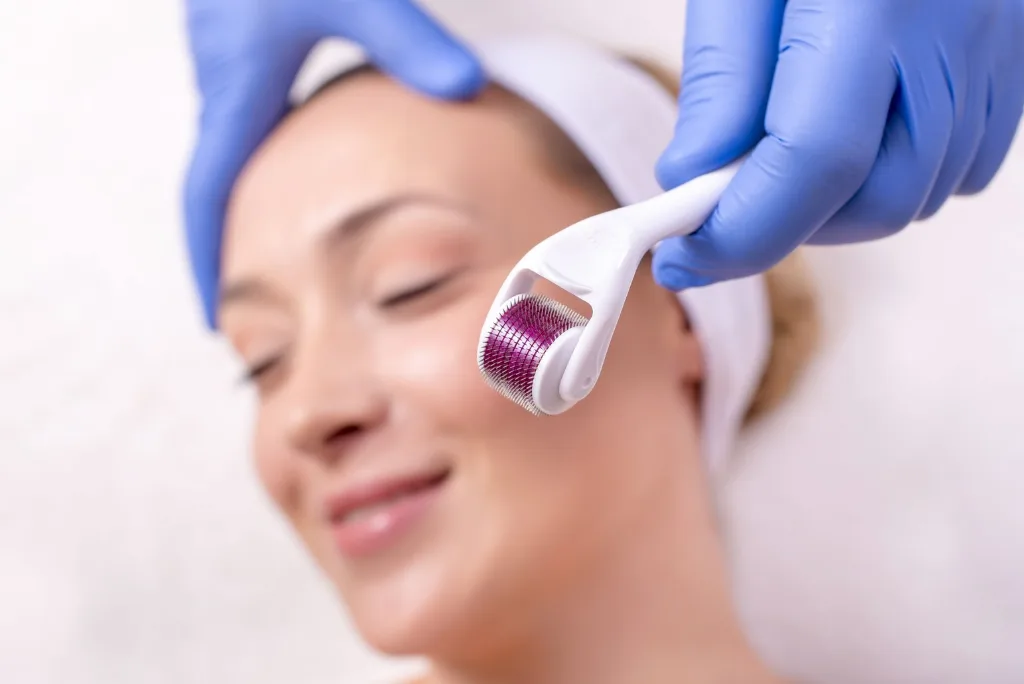
Two separate questions with two different answers.
For acne scars, the honest answer depends on the scar type. Rolling scars with soft sloping edges may soften slightly with repeated clinical microneedling. Boxcar scars respond better to resurfacing. Ice-pick scars are tethered down by fibrous bands and will not lift with any needling, at home or in clinic, until those bands are released. An at-home roller does not reach any of these. If scars are your concern, an assessment that classifies the scar type comes first, then the right tool, which may be fractional laser resurfacing or a combination approach.
For hair loss, the picture is more encouraging. Scalp microneedling alongside a prescribed topical treatment has shown better results in published work than the topical alone, likely through improved absorption and local growth factor activity. That said, the studies used controlled depths and intervals under supervision. Rolling an unsterile device across an inflamed or infected scalp sets you back. If hair thinning is the issue, scalp-focused options such as PRP therapy or the wider hair restoration treatments we offer are assessed against the cause of your shedding, which is the step most people skip.
How Do You Use a Derma Roller Safely at Home?
If you have one and intend to keep using it, use it the way it can actually help rather than the way the packaging suggests.
- Stay at 0.25 to 0.5 mm. Anything longer belongs in a clinic, whatever the seller claims.
- Treat it as single-person, short-life. Never share it, and replace it after ten to fifteen uses.
- Clean before and after. Soak in isopropyl alcohol for several minutes each time, and store it dry in its case.
- Roll on clean, dry skin. Light pressure, a few passes per direction. Pressing harder does not deepen the benefit, only the trauma.
- Skip actives that night. No acids, no retinoids, no vitamin C immediately afterwards. Compromised skin absorbs far more than intact skin, and that is how chemical burns happen.
- Use sunscreen religiously for the next week. This is not optional on our skin, especially through Lahore and Multan summers.
- Space sessions. Once every two weeks at most at these depths.
- Stop at the first sign of trouble. Persistent redness, new dark patches or spreading spots mean stop and get it looked at.
Final Thoughts
A derma roller is a reasonable way to help a serum penetrate a little better. It is not a scar treatment, not a pore treatment, and on skin that pigments easily it carries a real risk of leaving marks that outlast whatever you were trying to fix.
If your goal is better texture and brighter skin, the roller is a minor player next to consistent sun protection and a properly matched routine. If your goal is treating scars, pores or laxity, the device you need delivers controlled depth and usually energy, and it belongs in trained hands.
At Le Lotus Clinique we assess skin before suggesting any needling, because the right answer depends on what is actually causing the problem rather than what is trending. Our teams in Islamabad, Lahore, Karachi, Multan, Peshawar and Rawalpindi see roller-related pigmentation often enough that we would rather you asked first. You can book an assessment at the branch nearest you.
Frequently Asked Questions
How often should I use a derma roller at home?
Does a derma roller help with open pores?
Can I use a derma roller with vitamin C or retinol?
Is professional microneedling worth it compared with a home roller?
How long before I see any result from a derma roller?
A derma roller costs less than a cup of coffee in most online stores here, which is exactly why I see the damage it causes
Almost every week someone sits across from me, pinches the fat above their waistband, and asks whether the freezing treatment they saw online will get

Let me clear something up before anything else. Dark underarms are not a hygiene problem. I say this at the start of almost every consultation,