


A woman in her late twenties came to us having spent four years threading her chin every ten days. She had tried three courses of laser at different places. Each one worked for a few months, then the hair came back thicker than before.
Nobody had checked her hormones.
That is the pattern I see most often with facial hair in women. The hair gets treated repeatedly, the reason it is growing never does, and the patient is left thinking laser does not work on her. Laser works. It just cannot switch off the signal telling the follicles to produce more.
Quick summary: facial hair in women is usually hormonal, and polycystic ovary syndrome is the most common cause. Get assessed and treated for the hormonal side, then use laser or electrolysis to clear what is already there. Doing it in that order is what makes the results last. |
Why PCOS Causes Facial Hair
Polycystic ovary syndrome affects how the ovaries function and raises levels of androgens, the hormones usually present in much smaller amounts in women.
Androgens change the hair follicle itself. Fine, pale, barely visible hair on the chin, upper lip, jawline and neck converts into coarse, dark, deeply rooted hair. The medical term for that pattern of growth is hirsutism.
Two things follow from this that matter for treatment.
The follicle has physically changed, so it will keep producing coarse hair until the hormonal signal changes. And the areas affected follow a predictable male-pattern distribution, which is why chin, upper lip and jawline are typically first.
Insulin resistance is commonly part of the picture too, which is why weight, blood sugar and hair growth are often connected in the same patient.
Is It PCOS or Something Else?
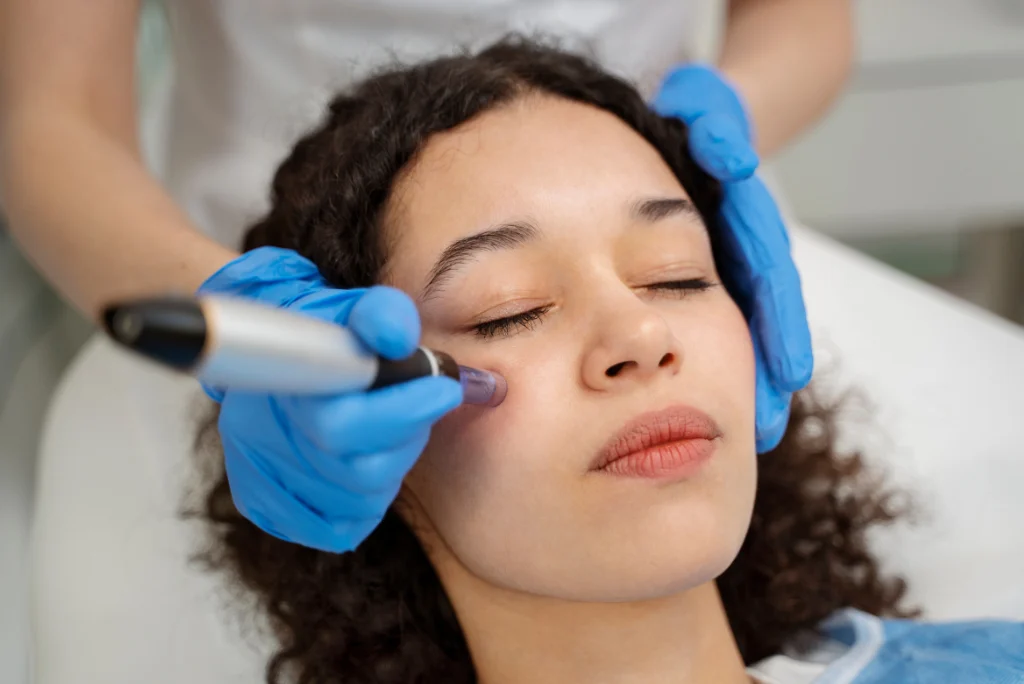
Not all facial hair in women is PCOS. Several other causes exist and they need excluding before anyone assumes.
Possible cause | What else you would notice |
PCOS | Irregular or absent periods, acne, weight gain, difficulty conceiving, hair thinning on the scalp |
Thyroid disorder | Fatigue, weight change, dry skin, cold intolerance |
Medication | Certain hormonal treatments and steroids |
Family tendency | Facial hair in female relatives, normal periods, no other symptoms |
Rapid onset | Hair appearing suddenly over months, with voice or body changes, needs urgent assessment |
That last row matters. Facial hair that appears quickly, alongside a deepening voice or other changes, is not a cosmetic issue and should be investigated promptly.
Why Treating the Hair Alone Never Lasts
This is the part most patients are never told.
Laser destroys hair follicles that are currently producing coarse, dark hair. It cannot do anything about follicles producing fine, pale hair today, because the laser needs pigment to target.
In untreated PCOS, androgens continue converting those dormant fine-hair follicles into coarse-hair follicles month after month. So you finish a course of laser, the treated hair is gone, and six months later new coarse hair appears from follicles that were invisible when you started.
The laser did not fail. The supply line was never interrupted.
Treat the hormonal side and that conversion slows or stops. Then laser is clearing a fixed number of follicles rather than chasing a moving target.
Why Waxing and Threading Make It Harder
Most patients arrive having threaded or waxed for years, and it works against them in two ways.
Repeated pulling irritates the follicle, and chronic irritation around the chin and jaw can leave darker skin behind. Many women come in concerned about facial pigmentation that turns out to be years of hair removal rather than a pigment disorder in itself.
It also causes ingrown hairs and small inflamed bumps along the jawline, which in some skin types leave marks that outlast the hair.
If you are planning laser, you will need to stop waxing, threading and plucking beforehand, because the treatment targets hair in the follicle and those methods remove the root. Shaving is fine in the meantime, and it does not make hair thicker despite what everyone says.
What Actually Treats the Hair
Once the hormonal side is being managed, there are two options worth knowing about, and the right one depends on the hair itself.
Laser hair removal targets the pigment in the hair shaft and destroys the follicle. It is the most efficient option for coarse, dark hair across larger areas such as the jawline, neck and upper lip. PCOS patients usually need more sessions than average and ongoing maintenance, which is normal rather than a sign something has gone wrong.
Electrolysis treats each follicle individually with a fine probe and does not depend on pigment. That makes it the right answer for fine, light or grey hair that laser cannot see, and for small stubborn patches left after a laser course. It is slower, so it suits precision work rather than large areas.
Many patients do best with both. Laser clears the bulk of the coarse hair, electrolysis finishes what remains.
A note on skin tone. Most patients here fall into the deeper Fitzpatrick types, where incorrect laser settings can cause burns or pigmentation rather than hair reduction. What protects you is the experience of the person operating the device, which is a fair question to ask directly at consultation.
What About the Acne and Pigmentation That Come With It
PCOS rarely arrives alone. Hormonal acne along the jaw and chin is common, and so are the marks it leaves.
Anti-acne treatment addresses the active breakouts, which also prevents the scarring that follows. For the darker marks left behind by acne or by years of threading, chemical peels for pigmentation and Pico laser both work on that discolouration. We covered the wider picture in our guide to what pigmentation creams can and cannot do.
Scalp hair thinning is the other side of the same hormonal coin, and it affects many women with PCOS. That needs its own assessment rather than being treated as ordinary hair fall.
Daily sun protection matters throughout, since the facial areas being treated are exposed and pigmentation worsens quickly without it.
How Many Sessions, and What Results Are Realistic
Facial laser for PCOS-related hair usually takes eight to ten sessions spaced four to six weeks apart, compared with six to eight for most patients. Maintenance sessions once or twice a year are normal afterwards.
Realistic means a substantial reduction in hair density and thickness, with far less daily management. It does not mean a permanently hair-free face, and any clinic promising that for a hormonal condition is describing something that is not achievable.
The patients who do best are the ones whose PCOS is being managed in parallel. The ones who struggle are those treating only the hair.
Final Thoughts
If you have been fighting facial hair for years and nobody has looked at your hormones, that is where to start.
See a gynaecologist or endocrinologist for the PCOS itself. Get the bloods done. Have the insulin side assessed, because that often sits underneath everything else. Then, with that being managed, clear the existing hair properly with laser or electrolysis rather than threading it every ten days for another four years.
What I would avoid is booking course after course of laser without ever asking why the hair keeps coming. That path is expensive, demoralising, and it leaves patients believing their skin is the problem when it is not.
At Le Lotus Clinique our dermatologists will tell you honestly when facial hair needs a hormonal assessment first, and we will say so even when it means your treatment waits. Consultations are available at our clinics in Islamabad, Lahore, Karachi, Rawalpindi, Multan and Peshawar, and you can book a skin assessment at any of them. Female practitioners are available on request.
Frequently Asked Questions
Can laser hair removal cure PCOS facial hair?
Will the hair come back after laser if I have PCOS?
Is electrolysis better than laser for PCOS?
Does shaving make facial hair grow back thicker?
Why do I have dark patches where I thread?

A woman in her late twenties came to us having spent four years threading her chin every ten days. She had tried three courses of
Someone comes in having read that microneedling fixes acne scars. They’ve seen the before-and-afters. Then they get quoted two very different prices for two things
A woman came in last month with a shopping bag. Inside it were seven bottles: two biotin brands, a multivitamin, collagen powder, an imported hair