

There is a bottle of sunscreen in your bathroom drawer right now. You bought it after someone told you to. You wore it for about two weeks. Then one morning it left a grey film across your face, or it stung your eyes on the drive to work, or it slid off by noon, and it went into the drawer.
That’s the real problem. Not which brand you bought. Whether you’ll still be wearing it in March.
I ask patients about sunscreen constantly, and the answer is seldom “I don’t own any.” It’s “I have it, I just don’t use it.” Which means the useful conversation isn’t about SPF numbers. It’s about finding a formula you don’t have to talk yourself into every morning.
- The short version: the best sunscreen is the one you’ll put on tomorrow without thinking about it. Check that it says broad spectrum, pick a texture that suits your skin type, and use far more than you think you need. Everything else is detail.
Why people here give up on it
Four complaints, and I hear all of them every week.
- The white cast. This is the big one, and it’s worse the deeper your skin tone. A product designed and tested on pale skin can look genuinely ridiculous on ours
- The grease. In Karachi humidity, a heavy cream feels unbearable within an hour
- The stinging. Sunscreen migrating into your eyes when you sweat is miserable, and it puts people off permanently
- It pills under makeup. Little rolls of product every time you apply foundation over it
Here’s what matters: every one of those is a formula problem. Not a sunscreen problem. Gels, fluids, and tinted formulas do none of these things, and finding one is about matching the texture to your skin rather than buying whatever was on the shelf.
If you gave up on sunscreen, you probably gave up on one bad match.
Mineral or chemical? The short answer
| Mineral | Chemical |
What’s in it | Zinc oxide, titanium dioxide | Filters like avobenzone, octinoxate, newer-generation filters |
How it works | Sits on the surface and reflects | Absorbs UV and converts it to heat |
Feels like | Thicker, more likely to leave a cast | Lighter, absorbs invisibly |
Best for | Sensitive skin, post-procedure skin, children | Daily wear, oily skin, under makeup |
The trade-off | Cast and texture | Occasional stinging, needs correct reapplication |
There is a lot of noise online about chemical filters being harmful. Evidence for meaningful harm at normal use is weak, and the harm of not wearing sunscreen in this climate is considerable. Don’t let an internet argument leave you unprotected.
For most people, a chemical or hybrid formula is the one they’ll actually keep wearing. Mineral is genuinely better if your skin is sensitive, reactive, or freshly treated.
What SPF and PA actually mean
This is where the most expensive misunderstanding lives.
SPF only measures UVB. That’s the burning radiation. It says nothing at all about UVA, which is the wavelength that drives pigmentation, melasma and premature ageing, and UVA is far more relevant to why most of my patients are sitting in front of me.
A high SPF with no UVA protection is a mediocre product wearing an impressive number.
SPF | Roughly blocks | Worth knowing |
15 | 93% of UVB | Not enough here |
30 | 97% | The realistic minimum |
50 | 98% | The sensible target for Pakistan |
100 | 99% | Marginal gain, often a false sense of security |
SPF 100 is not twice SPF 50. The curve flattens hard, and people wearing very high SPF tend to reapply less, which cancels out the advantage.
For UVA, look for one of these on the label:
- The words broad spectrum
- A PA rating — PA+ through PA++++. Aim for PA+++ or higher
- UVA in a circle, the European marking
If a bottle says SPF 60 and nothing else, put it back.
Choosing by skin type
Oily and acne-prone
The biggest group in my clinic, and the group that gives up most often.
Look for gel, fluid, or “watery” textures. Look for words like non-comedogenic, oil-free, and matte finish. Avoid thick creams and anything described as nourishing.
A properly matched sunscreen will not cause breakouts. A heavy one will.
Dry skin
Cream textures are fine and welcome here. Look for hydrating bases with glycerin or hyaluronic acid, and you may be able to skip a separate moisturiser.
Sensitive or reactive skin
Mineral, fragrance-free, minimal ingredients. If you’ve recently had a peel or laser, mineral is the right answer for at least the first couple of weeks — and your clinic should be telling you that.
Pigmentation or melasma
Tinted, without question. There’s a section on why below, and it’s the single most important choice on this list if pigmentation is your concern.
Children
Mineral, SPF 30 to 50, and applied properly rather than perfectly. The practical difficulty with children isn’t which bottle you buy, it’s reapplying every few hours. A stick formula for faces makes that far more likely to happen.
What "medicated sunblock" actually means
This term gets used constantly in Pakistan and rarely explained.
There’s no formal regulatory category. In practice, when a pharmacy sells you a “medicated” sunblock, it usually means a pharmacy-grade formulation rather than a cosmetic one — typically better UVA coverage, often with added actives like niacinamide or an antioxidant, frequently tinted, and generally formulated with our skin tones in mind rather than adapted for them.
You genuinely need this level if:
- You have melasma or active pigmentation being treated
- You’ve had a peel, laser or any resurfacing procedure
- You’re using a retinoid, hydroquinone or any prescription topical
- You’ve had skin cancer or precancerous lesions
- You’re on medication that increases photosensitivity, including some antibiotics
You probably don’t need it if you’re generally healthy, not treating anything, and simply want daily protection. A good cosmetic sunscreen worn consistently beats a medicated one used twice a week.
If you’re being treated for pigmentation, consider the sunscreen part of the prescription rather than an optional extra. It does more work than the cream does.
Tinted sunscreen, and why it matters more here
This is the part most international articles skip, and it’s the one that matters most for Pakistani skin.
Visible light triggers melasma. Not just UV — ordinary visible light, the kind coming through your window and off your screen. Clear sunscreens do nothing against it, essentially.
Iron oxides, the pigments that make a sunscreen tinted, do block visible light. That’s why tinted formulas outperform clear ones for melasma even at identical SPF.
And they solve the white cast, because a tint is designed to blend rather than sit on top. So the formula that works best clinically for pigmentation is also the one most likely to stay in your routine.
If you have melasma or you’re being treated for dark spots, tinted is not a preference. It’s the correct choice.
How much, how often, and where it goes wrong
Almost everyone under-applies. By a lot.
The amounts:
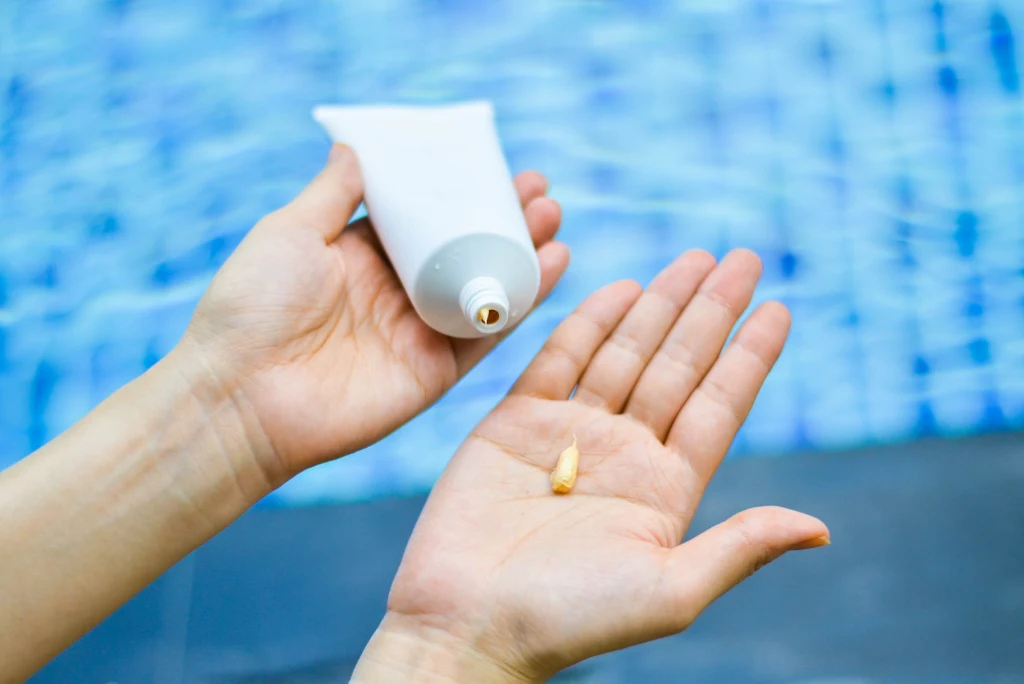
- Roughly two finger-lengths of product for the face and neck. Squeeze it along your index and middle finger — that’s the dose
- Most people use about a quarter of that, which means a bottle labelled SPF 50 is performing somewhere closer to SPF 15
The timing:
- Reapply every three to four hours if you’re outdoors
- After swimming or heavy sweating, regardless of what the bottle claims
- Morning application alone is not enough for a full day out
Where people miss:
- Ears, and the back of the neck
- Hands, which age faster than anything else and get the most sun through a car window
- Up to the lash line, which is the area people protect least and where dark circles and pigmentation are most visible
- Indoors near a window, because UVA passes straight through glass
Two other things:
The SPF in your foundation or moisturiser doesn’t count. To get the labelled protection from a foundation you’d have to apply an unwearable amount.
And don’t leave the bottle in your car. Heat degrades filters, and Pakistani car interiors in June are well past what any formulation was tested for.
What sunscreen won't do
It won’t reverse damage that’s already there. It prevents more.
It won’t clear melasma by itself, though nothing else will hold without it.
It doesn’t make you invincible at two in the afternoon in Multan in June. Shade, timing and sunglasses still matter, and sunglasses do real work for the eye area specifically.
If the damage is already there
Sun damage shows up in three predictable ways, and by the time people notice, they’ve usually had it for years.
Pigmentation — melasma, sun spots, uneven tone. This responds to Pico laser, Q-switch laser and chemical peels for pigmentation, usually alongside a topical plan.
Enlarged pores and texture change. UV breaks down the collagen scaffolding that holds pores in shape, which is why sun-damaged skin has the most visible pores. We covered what actually causes enlarged pores separately.
Early lines and laxity, which arrive a decade earlier than they need to.
None of it is untreatable. All of it is cheaper and easier to prevent than to correct, which is the entire argument for the bottle in your drawer.
Final thoughts
Sunscreen is the only thing in skincare where the science is settled, and the argument is over. Every problem people come to me about pigmentation, texture, pores, early lines is either caused by sun exposure or made significantly worse by it.
And yet compliance is terrible, because most people were handed the wrong formula once and concluded that sunscreen isn’t for them.
So find one you like. Gel if you’re oily, cream if you’re dry, mineral if you’re sensitive, tinted if you have pigmentation. Check it says broad spectrum. Use two fingers’ worth. Put it on before you leave, not after you’ve already been in the sun.
That’s it. That’s the whole routine, and it will do more for your skin over ten years than anything else you buy.
Frequently Asked Questions
What's the difference between medicated and regular sunblock?
Will sunscreen cause vitamin D deficiency?
Which SPF is best for Pakistan?
Is expensive sunscreen better?
Do I need sunscreen indoors?

Someone comes in having read that microneedling fixes acne scars. They’ve seen the before-and-afters. Then they get quoted two very different prices for two things

A woman came in last month with a shopping bag. Inside it were seven bottles: two biotin brands, a multivitamin, collagen powder, an imported hair
There is a bottle of sunscreen in your bathroom drawer right now. You bought it after someone told you to. You wore it for about