

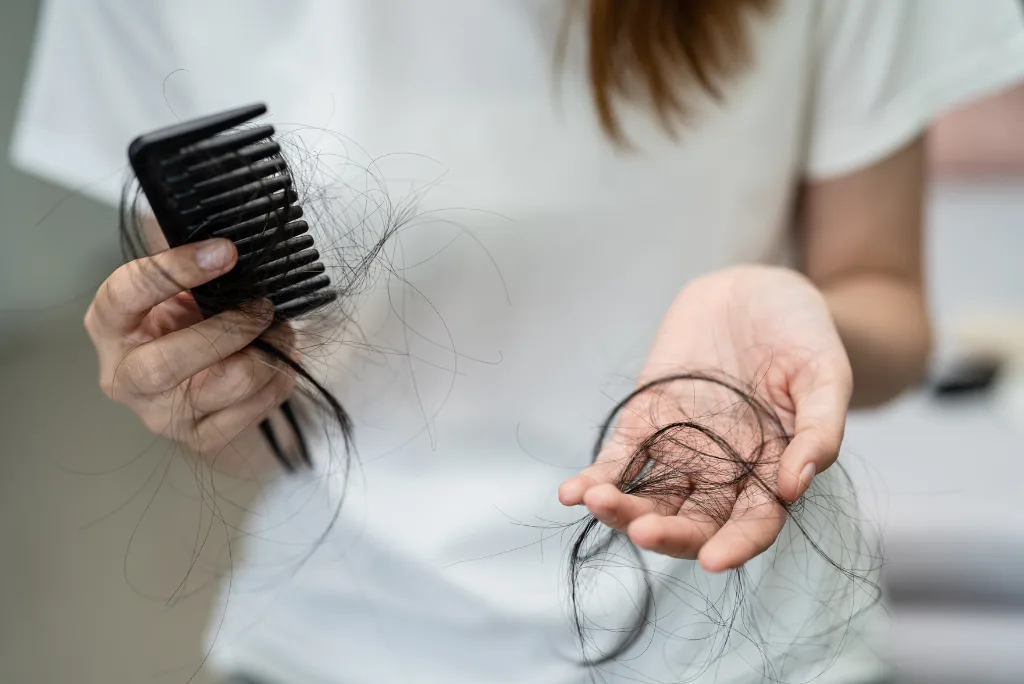
A woman came in last month with a shopping bag. Inside it were seven bottles: two biotin brands, a multivitamin, collagen powder, an imported hair gummy, zinc, and something a relative had brought from Dubai. She’d been taking all of them for five months. Her hair was still coming out in the shower.
We ran three blood tests. Her ferritin was 8.
She didn’t need a bag of supplements. She needed iron, and she needed someone to check before she spent the money.
That’s the whole point of this article. Nutritional deficiency is one of the most common causes of hair fall in Pakistan and one of the easiest to fix, but only if you find out which one you actually have. Guessing is how people lose a year.
- The short version: iron is the big one, especially in women. Vitamin D, B12, zinc, and thyroid come next. Biotin is the most-bought and least-needed of the lot. Test first. Three or four blood tests cost less than two months of supplements.
First, does your hair fall even look nutritional?
Deficiency-related hair loss has a particular pattern, and it’s worth knowing whether yours fits before you go anywhere near a lab.
It usually looks like this:
- Diffuse shedding across the whole scalp, not one bald patch
- More hair in the shower drain, on the pillow, in the brush
- The ponytail feels thinner than it did
- The parting looks slightly wider
- It started somewhere between two and four months after something happened — an illness, a pregnancy, crash dieting, a surgery, a period of real stress
That two-to-four month delay confuses almost everyone. Hair doesn’t fall out the week something goes wrong. The follicle shifts into its shedding phase and the hair comes out months later, which is why people connect it to the wrong event. If your hair started falling in September, look at what was happening in May.
It probably isn’t nutritional if:
- You have a defined round bald patch; that’s a different condition
- Your hairline is receding at the temples, or the crown is thinning in a pattern; that’s genetic
- There’s redness, scaling, or pain on the scalp
- Only your husband’s father’s side of the family has it, and you’re a 28-year-old man watching the same thing happen
Understanding why hair falls in the first place matters more than any supplement, because the treatment for a deficiency and the treatment for pattern loss have nothing in common.
The deficiencies that actually matter
Five things account for nearly all nutritional hair loss I see. Here they are in order of how often they turn out to be the culprit.
Deficiency | Who it hits | What else you’d notice | Test to ask for |
Iron (ferritin) | Women, especially with heavy periods, pregnancy, or a mostly vegetarian diet | Tiredness, breathlessness on stairs, brittle nails, pale skin | Serum ferritin, plus CBC |
Vitamin D | Almost everyone in Pakistan, despite the sunshine | Aches, low mood, frequent illness, poor sleep | 25-hydroxy vitamin D |
Thyroid | Women 25 to 50, and after pregnancy | Weight change, cold intolerance, fatigue, dry skin | TSH, and free T4 if TSH is off |
Vitamin B12 | Vegetarians, and anyone on long-term acid reflux medication | Tingling in hands or feet, fatigue, low mood | Serum B12 |
Zinc | Poor diet, gut absorption problems | Slow wound healing, taste changes, acne | Serum zinc |
Iron is the one to check first. Ferritin is the number that matters, not haemoglobin. You can have completely normal haemoglobin and a ferritin low enough to shed hair, which is exactly why so many women are told their blood is fine and sent home. Hair follicles are demanding tissue and they lose the queue for iron before anything vital does.
Vitamin D is nearly universal here, which is the strange part. We are a sunny country with widespread deficiency, because most people are indoors during peak hours, covered when outside, or wearing sunscreen, which they should be. Deficiency alone rarely causes dramatic hair fall, but it makes everything else worse.
Thyroid gets missed constantly. It isn’t a vitamin, so nobody thinks to test it, and it is one of the most common reversible causes of diffuse shedding in women. If you’re going to run four tests, make TSH one of them.
What to actually ask the lab for
You don’t need a fifteen-test panel. Walk in and ask for these:
- Serum ferritin
- 25-hydroxy vitamin D
- TSH
- CBC
- Add B12 if you’re vegetarian or on long-term omeprazole
- Add serum zinc only if there’s a reason to suspect it
That’s it. Most labs in Pakistan will run the first four together for a reasonable amount, and a vitamin D test on its own is inexpensive and widely available.
Reading the results is where people get stuck. A number inside the “normal range” printed on your report is not the same as a number that’s good enough for hair.
Test | Lab says normal from | What hair actually wants |
Ferritin | Around 15 ng/mL | Comfortably above 30, often better nearer 50 to 70 |
Vitamin D | Around 20 ng/mL | 30 or above |
TSH | Roughly 0.4 to 4.5 | Anywhere near the top end deserves a second look |
This is the single most useful thing in this article. A ferritin of 18 will be printed in black rather than red, you’ll be told everything is fine, and your hair will keep falling. Take the actual numbers to someone who will interpret them rather than just scan for flagged values. Our hair specialists will read a report with you properly.
Now, about biotin
Biotin is the most purchased hair supplement in Pakistan. Nutrifactor, imported gummies, the shampoos, the tablets your cousin swears by.
True biotin deficiency is rare. Genuinely rare. It happens in people with specific absorption disorders or on particular long-term medications, and if you have it, you’ll usually have other symptoms long before hair loss: rashes, neurological problems.
Taking biotin when you’re not deficient does approximately nothing for your hair.
Worse, it interferes with laboratory assays. High-dose biotin can distort thyroid and other hormone test results, which means the supplement you’re taking for your hair can hide the thyroid problem causing it. If you’re taking biotin, stop it three to five days before any blood test and tell whoever ordered it.
I’m not telling you biotin is dangerous. I’m telling you that for most people it’s an expensive placebo, and it’s one that occasionally sabotages the test that would have found the real answer.
Quick verdicts on the rest of the shelf:
Supplement | Worth it? |
Iron | Yes, if you’re deficient. Genuinely harmful if you’re not — excess iron is stored, not excreted |
Vitamin D | Yes, if deficient. Dosing depends on how low you are, so get it prescribed rather than guessed |
B12 | Yes, if deficient or vegetarian |
Zinc | Only if tested and low. High-dose zinc blocks copper absorption |
Biotin | Almost never needed. See above |
Collagen powder | Weak evidence for hair specifically. Not harmful, not a priority |
Multivitamins | Fine as general cover. Not a treatment for a real deficiency, because the doses are too low |
Hair gummies | Usually a multivitamin with sugar and a higher price |
The part nobody wants to hear: it takes months
Once you’re correcting an actual deficiency, here’s the honest timeline.
- Weeks 1 to 6: Shedding may even continue or briefly worsen
- Weeks 6 to 12: Shedding slows. This is the first real sign, and it’s a reduction in fall, not new growth
- Months 3 to 6: short new hairs appear along the parting and hairline. They stick up and look untidy. That’s exactly what you want to see
- Months 6 to 12: density visibly improves
Nobody sticks with it long enough. People take iron for six weeks, see no new hair, decide it isn’t working and move to the next bottle. Six weeks is barely the beginning.
Recheck your ferritin at three months rather than guessing, because iron supplements need to actually be raising the number, and some formulations absorb poorly.
What if all your tests come back normal?
This happens often, and it’s useful information rather than a dead end. It usually means one of three things.
Pattern hair loss. Genetic, progressive, and the most common cause of hair thinning in both men and women. It doesn’t respond to supplements at all, and treating it early matters much more than treating it aggressively later.
Telogen effluvium that’s already resolving. A shedding episode triggered by an event three or four months ago, which will settle on its own. This needs patience and not much else.
A scalp condition — seborrheic dermatitis, or something inflammatory that needs looking at directly rather than through a blood report.
For genuine pattern loss caught reasonably early, some options work and don’t involve surgery. We’ve written about how to fix thinning hair without a transplant in detail, and the two mainstays are PRP for hair, which uses your own platelets to stimulate the follicles, and exosome therapy for hair, which is the newer regenerative option.
Where loss is more advanced and the follicles are gone rather than weakened, no injection recreates them. That’s the point at which hair transplant and restoration becomes the honest answer, and it’s worth knowing what a transplant costs per graft in Pakistan before anyone quotes you a package. For men who want the appearance of density without surgery, scalp micropigmentation is a reasonable alternative.
But please, in that order. Test, correct, wait, then treat.
Come and get it looked at if
- Your hair has been falling for more than three months
- You’re seeing scalp through your parting
- You have symptoms alongside it — fatigue, weight change, heavy periods
- Your report came back “normal” but nothing has improved
- You’ve been taking supplements for six months with no change
- You’re a man noticing temple recession, where early treatment genuinely changes the outcome
You can book a hair assessment at any of our branches. Bring your blood reports if you have them, and bring the supplements you’re taking, including the ones someone brought from abroad. Half of what I do in these consultations is telling people what to stop.
Final thoughts
Most of the hair fall I see doesn’t need treatment. It needs three blood tests and four months of patience.
The pattern is always the same. Someone notices hair in the drain, panics, buys biotin, adds a serum, tries an oil, changes shampoo twice, and arrives eight months later having spent a great deal without ever finding out what was wrong. Meanwhile, the ferritin that would have explained everything sat untested the whole time.
So test first. Read the actual numbers rather than trusting the word “normal”. Correct what’s genuinely low, under supervision. Give it three to six months. And if everything comes back clean, that’s not a wasted trip; it’s the answer, and it points you somewhere entirely different.
At Le Lotus Clinique we assess hair loss by cause before recommending anything, because the plan for low ferritin and the plan for pattern baldness share nothing at all. You’ll find us in Islamabad, Lahore, Karachi, Rawalpindi, Multan and Peshawar.
Frequently Asked Questions
Which vitamin deficiency causes hair loss most often?
Can vitamin D deficiency cause hair loss?
Does biotin actually work for hair?
How long before my hair grows back?
What is ferritin and why does it matter more than haemoglobin?

Someone comes in having read that microneedling fixes acne scars. They’ve seen the before-and-afters. Then they get quoted two very different prices for two things

A woman came in last month with a shopping bag. Inside it were seven bottles: two biotin brands, a multivitamin, collagen powder, an imported hair

There is a bottle of sunscreen in your bathroom drawer right now. You bought it after someone told you to. You wore it for about