

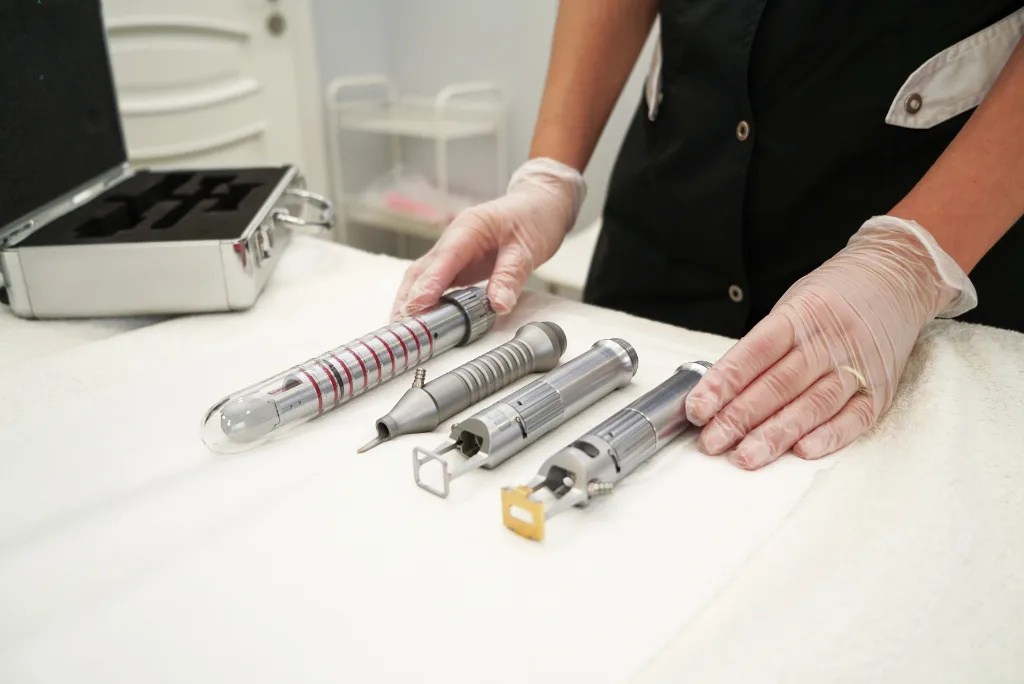
Someone comes in having read that microneedling fixes acne scars. They’ve seen the before-and-afters. Then they get quoted two very different prices for two things that sound almost identical, and nobody explains why.
Here’s the difference in one line: standard microneedling works on the surface; RF microneedling works underneath it. Which one you need depends entirely on what you’re trying to fix.
- The short version: if your concern is texture, dullness or shallow marks, standard microneedling is usually enough. If it’s deeper acne scars, early sagging or loose skin, you need the RF version. And if you have brown skin, there’s a safety reason to read the section below before booking either.
What does microneedling actually do to your skin?
A fine needle makes a controlled injury. Your skin responds by producing collagen to repair it. Do that across the whole face, in a grid, and you get a wave of new collagen over the following weeks.
That’s the whole mechanism. It’s sometimes called collagen induction therapy, which is a more honest name for it.
The needles reach the upper layers of the dermis. That’s deep enough to improve texture, soften shallow marks, and refine enlarged pores. It is not deep enough to tighten skin that has genuinely started to sag.
Results build over about three months as the collagen matures. You won’t walk out looking different.
What does RF microneedling add?
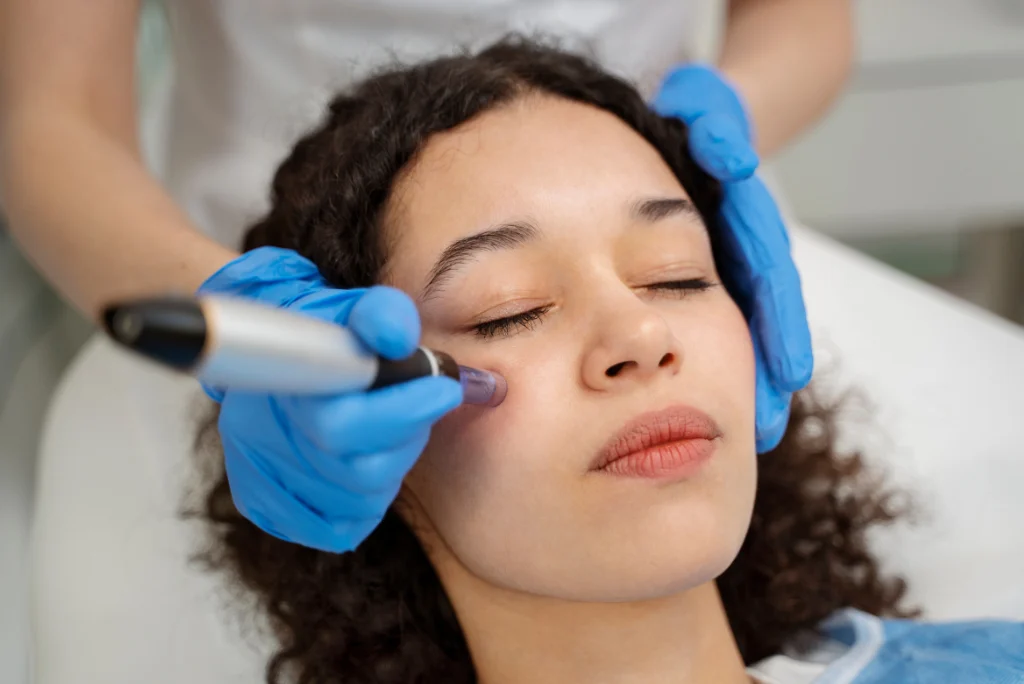
Same needles, with one addition: they’re insulated, and they deliver radiofrequency energy from the tip once they’re inside the skin.
That changes two things.
It goes deeper. The energy releases in the mid to deep dermis, which is where scar tissue sits and where the collagen that holds your face up actually lives.
It heats the tissue. Controlled heat causes existing collagen to contract immediately and triggers stronger remodelling over the following months. Heat is what produces tightening. Needles alone don’t do it.
The important part for our patients: because the needles are insulated, the energy is released at depth rather than at the surface. The top layer of skin takes less damage. That matters more here than it does in London, and the next-but-one section explains why.
What is the difference between microneedling and RF microneedling?
| Standard microneedling | RF microneedling |
How it works | Micro-injuries trigger collagen repair | Micro-injuries plus radiofrequency heat at depth |
Reaches | Upper dermis | Mid to deep dermis |
Best for | Texture, dullness, shallow marks, pores | Deeper acne scars, laxity, early jowls, stretch marks |
Tightening | Minimal | Yes, this is its main advantage |
Surface trauma | More | Less, because needles are insulated |
Downtime | 1 to 2 days | 2 to 4 days |
Sessions | 4 to 6 | 3 to 4 |
Cost | Lower | Higher |
If you only take one row from that table, take the tightening one. That’s why the two treatments exist separately.
Which one is right for your concern?
Acne scars
Depends on the scar. Shallow, rolling scars respond well to standard microneedling over a course. Deeper boxcar and ice-pick scars sit in the mid dermis, and needles alone won’t reach the fibrous tissue anchoring them down. That’s RF territory, and sometimes the answer is CO2 fractional laser instead.
Enlarged pores and rough texture
Standard microneedling is usually sufficient and cheaper. If the pores are tear-shaped and sagging rather than round, the cause is collagen loss and RF will do more.
Early sagging and loose skin
RF, without question. This is the one thing standard microneedling genuinely cannot do.
Fine lines
Both help. RF does more around the jaw and lower face. Standard is fine for crepey texture on the cheeks.
Dullness and general skin quality
Standard microneedling, or honestly a course of HydraFacials if that’s your only concern. Don’t pay for RF to fix dullness.
Stretch marks and scars on the body
RF, because the tissue is thicker and needs the depth.
Is RF microneedling safe for brown skin?
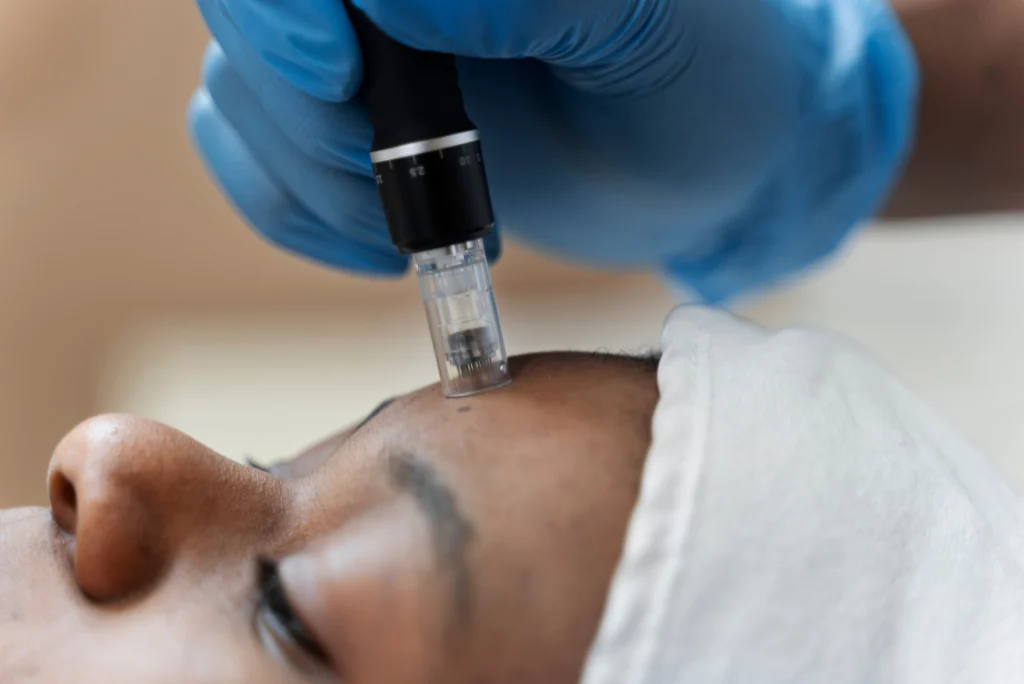
This is the section the international articles skip, and it’s the most important one for most people reading this in Pakistan.
Darker skin produces pigment in response to inflammation. Any treatment that traumatises the surface risks post-inflammatory hyperpigmentation, which means you go in for acne scars and come out with dark patches that take months to fade.
RF microneedling is generally the safer option on Fitzpatrick IV to VI skin, and the reason is mechanical rather than marketing. The needles are insulated, so the energy discharges at depth instead of at the epidermis. Less surface trauma means less inflammatory pigment response.
That doesn’t make it risk-free. What actually determines your outcome is the settings, and settings depend on whether the person holding the device has treated skin like yours before. This is the single most important question to ask at a consultation, more important than which brand of machine the clinic advertises.
If you already have melasma or active pigmentation, that needs assessing and often settling before either treatment.
How many sessions will you need, and what's the downtime?
Standard microneedling: usually 4 to 6 sessions, spaced 4 weeks apart. Expect redness like mild sunburn for a day or two, slight roughness for about three days.
RF microneedling: usually 3 to 4 sessions, spaced 4 to 6 weeks apart. Redness and swelling for 2 to 4 days, and you may see a faint grid pattern on the skin for a few days afterwards. That’s normal.
For both, strict sun avoidance afterwards, and daily sunscreen is not optional. Treating skin and then exposing it to Pakistani sun is how good treatments produce bad outcomes.
What are the side effects of RF microneedling?
Common and expected: redness, mild swelling, dryness, tightness, some flaking around day three.
Less common: bruising, temporary grid marks, small spots as the skin purges.
What you’re actually trying to avoid: post-inflammatory hyperpigmentation, burns from incorrect energy settings, and infection from poor sterilisation. All three come down to who performs it and where, not the treatment itself.
Don’t book either treatment if you have an active skin infection, cold sores flaring, or if you’re pregnant. Tell whoever assesses you if you’re on isotretinoin or have a history of keloid scarring.
What do realistic before and after results look like?
Manage your expectations here, because the photographs online are not a fair sample.
- After one session: your skin looks brighter and feels smoother once the redness settles. That’s surface hydration and mild swelling, not collagen.
- After the full course: the real change. Texture is smoother, pores look refined, shallow scars have softened.
- Three to six months after finishing: peak results, because collagen keeps remodelling long after the last session.
For acne scarring, realistic improvement across a full course is meaningful but partial. Anyone promising clearance in one session is selling you something.
Can you combine either one with PRP?
Yes, and it’s a genuinely good pairing. PRP uses growth factors from your own blood, applied to skin that has just been micro-channelled, so absorption is far better than it would be on intact skin.
It adds cost. It suits people whose main concern is healing quality and overall skin condition rather than tightening. If your problem is laxity, put the money into RF rather than into add-ons.
What does microneedling cost in Pakistan?
Prices vary widely between clinics, and the spread is wider than it should be.
Treatment | Typical range per session |
Standard microneedling | Lower end |
Microneedling with PRP | Mid range |
RF microneedling | Higher end |
Two things worth knowing. RF costs more because the device costs more and the consumable tips are single use, which is also a hygiene point worth asking about. And packages quoted per course are usually better value than paying per session, but only commit to a course after an assessment confirms which treatment you actually need.
If a price looks dramatically below the market, ask what device is being used, whether tips are single use, and who is performing it. That’s usually where the saving comes from.
Final thoughts
Most of the confusion here is created by clinics using the two names interchangeably when the treatments do different jobs.
Standard microneedling is a good, affordable, reliable treatment for texture and surface concerns. RF microneedling is the one that reaches deep enough to tighten and to reach real scar tissue, and on brown skin it carries a lower pigmentation risk because it spares the surface.
Neither is better. One is deeper.
At Le Lotus Clinique we run Sylfirm X and Scarlet RF, and we’ll tell you honestly when the simpler treatment is the right one. You can book a skin assessment at our clinics in Islamabad, Lahore, Karachi, Rawalpindi, Multan and Peshawar.
Frequently Asked Questions
Does microneedling with RF really work?
How many times do you need RF microneedling?
Is RF microneedling painful?
Can I wear makeup afterwards?
Can I do this at home with a derma roller?
Someone comes in having read that microneedling fixes acne scars. They’ve seen the before-and-afters. Then they get quoted two very different prices for two things
A woman came in last month with a shopping bag. Inside it were seven bottles: two biotin brands, a multivitamin, collagen powder, an imported hair

There is a bottle of sunscreen in your bathroom drawer right now. You bought it after someone told you to. You wore it for about