

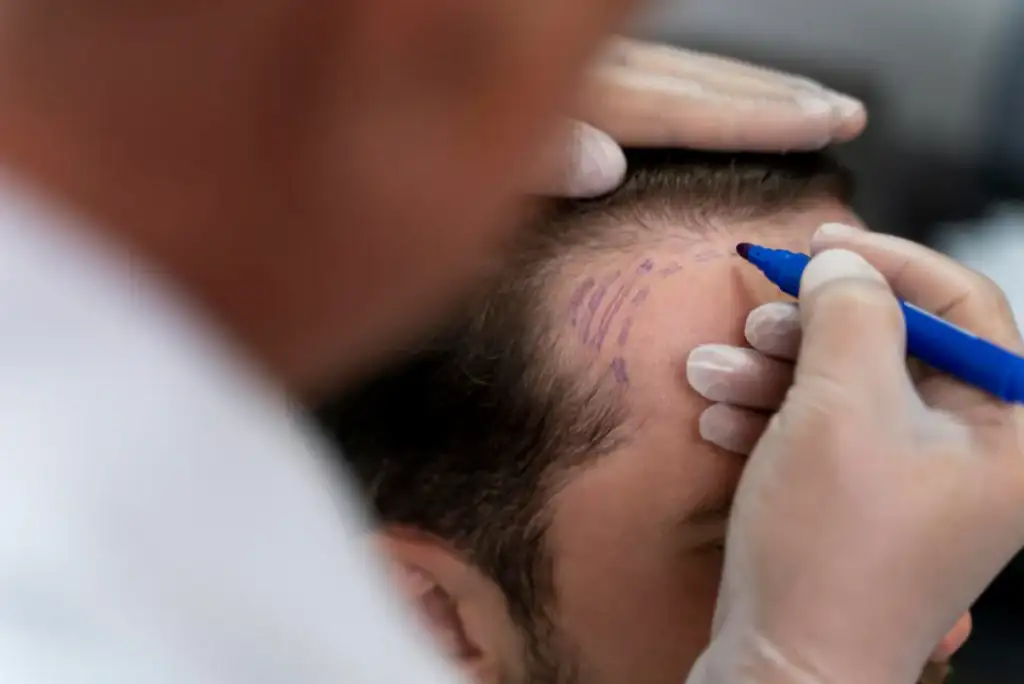
A hair transplant moves healthy hair follicles from the back of your head to the areas where hair has thinned or receded. In Islamabad, most people need between 1,500 and 3,500 grafts. The procedure takes one day, and the final result shows at around 12 months.
The results depend far more on who performs the procedure and how well it is planned than on the technique’s name. This guide covers who is a good candidate, how many grafts you are likely to need, what it costs, how recovery unfolds month by month, and what to check before you choose a clinic. For a graft estimate and hairline plan based on your own scalp, you can book a consultation at Le Lotus Clinique.
| Most common technique | FUE (Follicular Unit Extraction) |
| Grafts most people need | 1,500 to 3,500 |
| Procedure time | 6 to 8 hours, under local anaesthesia |
| Back to a desk job | 5 to 7 days |
| New growth starts | Around month 3 to 4 |
| Final result | 12 months (up to 18 months for the crown) |
| Typical market cost | Rs. 70 to Rs. 150 per graft |
Are You a Good Candidate for a Hair Transplant?
A hair transplant works best when hair loss has a clear pattern and there is enough healthy hair at the back and sides to move. Not everyone with thinning hair is ready for surgery.
| Usually a good candidate | Usually not ready yet |
| Male or female pattern hair loss that has been stable for a year or more | Hair loss that is still progressing quickly |
| Dense, healthy hair at the back of the head (the donor area) | A thin or weak donor area |
| Age 25 or older, when the pattern is clearer | Young men in their early twenties whose loss pattern is not yet clear |
| Realistic expectations about density | Patchy hair loss from alopecia areata |
| Good general health | Hair loss caused by thyroid problems, iron deficiency or stress that has not been treated |
If your hair loss is recent, start by finding the cause. Our guide to vitamin deficiencies and hair loss explains the blood tests worth doing first, and our alopecia treatment guide covers patchy hair loss.
FUE vs FUT vs DHI: Which Technique Is Used in Islamabad?
Most clinics in Islamabad offer FUE as standard. FUT and DHI are offered less often. Here is how they compare:
| FUE | FUT | DHI | |
| How it works | Grafts are taken one by one from the donor area | A thin strip of scalp is removed and divided into grafts | A form of FUE where grafts are placed with an implanter pen |
| Scarring | Tiny dot scars, hidden by short hair | One linear scar at the back of the head | Tiny dot scars |
| Recovery | Faster | Slower, stitches in the donor area | Faster |
| Best for | Most patients, especially those who wear their hair short | Patients needing a very large number of grafts who wear longer hair | Hairline work and dense packing in small areas |
| Cost | Mid to high | Lower per graft | Highest |
The technique matters less than the surgeon’s skill. A well-planned FUE in experienced hands will give a better result than a poorly done DHI, whatever it is called.
How Many Grafts Do You Need?
A graft is a small natural group of one to four hairs. Clinics quote by grafts, not by hairs. The number you need depends on the area being treated and how much density you want:
| Area | Typical number of grafts |
| Hairline only | 800 to 1,500 |
| Hairline and temples | 1,500 to 2,500 |
| Front third of the scalp | 2,000 to 3,000 |
| Crown | 1,000 to 2,000 |
| Whole top of the head | 3,500 to 5,000 or more |
Your donor area sets the limit. A good surgeon will tell you honestly how many grafts can be taken safely, and will prioritise the hairline and front if your donor supply cannot cover everything.
Hair Transplant Cost in Islamabad (2026)
In Pakistan, hair transplants are usually priced per graft. General market rates in 2026 are:
| Technique or size | Typical market range |
| FUE, per graft | Rs. 90 to Rs. 150 |
| FUT, per graft | Rs. 60 to Rs. 100 |
| 1,000 to 1,500 grafts | Rs. 90,000 to Rs. 160,000 |
| 2,000 to 2,500 grafts | Rs. 140,000 to Rs. 260,000 |
| 3,000 to 3,500 grafts | Rs. 190,000 to Rs. 360,000 |
These are general market ranges, not Le Lotus prices. Your price depends on your graft count, technique and donor area, and is confirmed after an in-person assessment.
Be careful with offers that are far below these ranges. Very cheap procedures often mean technicians do most of the work, grafts are handled roughly, or too many grafts are taken from the donor area. A second procedure to fix a poor result costs more than doing it properly once. For a full breakdown of what affects the price, read our hair transplant price guide for Pakistan.
What Happens on the Day
- Hairline design. The surgeon draws your new hairline, matched to your face shape and age. A hairline that is too low or too straight looks unnatural as you get older.
- Local anaesthesia. The donor and recipient areas are numbed. You stay awake throughout.
- Extraction. Grafts are taken from the back and sides of the head and kept in a cooled solution.
- Making the sites. Tiny openings are made in the thinning area at the right angle and direction for natural growth.
- Implantation. Each graft is placed into its site.
- Dressing and instructions. The donor area is dressed, and you go home the same day with medication and aftercare instructions.
Recovery Timeline: Day 1 to Month 12
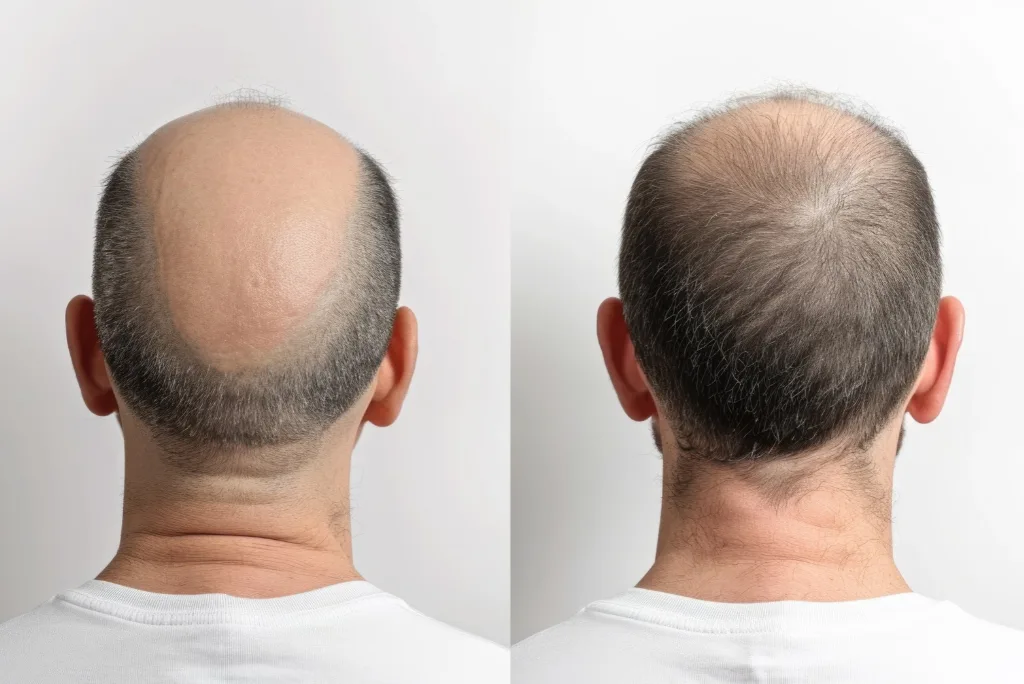
| When | What to expect |
| Days 1 to 3 | Mild soreness and some swelling of the forehead. Sleep with your head raised. |
| Days 7 to 10 | Small scabs fall away after gentle washing. Most people return to desk work. |
| Weeks 2 to 8 | The transplanted hairs shed. This is normal and expected, because the roots stay in place. |
| Months 3 to 4 | New, fine hairs start to grow. |
| Months 6 to 8 | A clear difference in coverage. Hair becomes thicker. |
| Month 12 | The final result for the front. The crown can take up to 18 months. |
During the first two to three weeks, avoid the gym, swimming, direct sun on the scalp and tight caps. Follow your clinic’s washing instructions exactly, because rubbing the area too early can dislodge grafts.
Risks and Side Effects
A hair transplant is minor surgery, and most side effects are short-lived:
- Swelling of the forehead for a few days
- Numbness or tingling in the donor area for a few weeks
- Itching while the scalp heals
- Shock loss, where some existing hair near the treated area sheds temporarily
- Small spots or ingrown hairs as new hair grows
Infection and poor graft growth are uncommon when the procedure is done in a clean clinical setting by an experienced team. Contact your clinic if you notice increasing pain, pus, spreading redness or a fever.
How to Choose the Best Hair Transplant Clinic in Islamabad
There are many hair transplant clinics in Islamabad, and prices vary widely. These checks will tell you more than any advert:
| Ask this | Why it matters |
| Who designs the hairline and makes the sites? | These steps decide how natural the result looks. A qualified doctor should do them. |
| Is the doctor PMDC-registered? | You can check registration on the Pakistan Medical and Dental Council website. |
| Can I see real before and after photos at 12 months? | Photos taken weeks after surgery do not show the final result. |
| Will I get my graft count in writing? | It protects you from paying for grafts you did not receive. |
| What aftercare is included? | Follow-up visits and a plan for your existing hair matter as much as the surgery. |
| How many procedures are done in one day? | Several surgeries at once can mean less time on yours. |
Protecting Your Results: PRP and Medication After Surgery
Transplanted hair is taken from the area least affected by pattern hair loss, so it usually lasts. Your existing hair, however, can keep thinning. Without a plan for it, you may need a second procedure later.
- PRP for hair: uses your own platelets to support the existing hair and help healing.
- Exosome therapy: another option to support thinning areas around the transplant.
- Medication: minoxidil, and for men finasteride, can slow further loss. Only start these after speaking to a doctor.
If you are not ready for surgery, read our guide on fixing thinning hair without a transplant.
Hair Transplant at Le Lotus Clinique, Islamabad
At our Islamabad clinic, every hair transplant starts with a doctor’s consultation, not a sales call.
- Scalp and donor assessment: we check the cause of your hair loss and how much donor hair you have.
- Hairline planned for your face: designed to suit you now and as you get older.
- Graft estimate in writing: you know the plan and the price before you book.
- Support for your existing hair: PRP and medical treatment where needed, so the result lasts.
- Follow-up: we review your growth through the first year.
For a graft estimate and a clear plan for your hair, book a consultation or message us on WhatsApp.
Frequently Asked Questions
Is a hair transplant permanent?
Is hair transplant allowed in Islam?
Does a hair transplant hurt?
When can I go back to work after a hair transplant?
Will my hair transplant look natural?
Can women have a hair transplant?
Planning a hair transplant in Islamabad? Learn how many grafts you need, FUE vs FUT, the recovery timeline and 2026 cost ranges.

Wondering what a HydraFacial costs in Pakistan? See 2026 price ranges by type, how many sessions you need, and what changes the price.

Every year from about April onwards, my consultation rooms fill with the same sentence: I have gone so dark this summer. Almost always the person